Sanitary Flow Meters for Food and Beverage: A Specialist Guide
Ask a generalist instrument supplier what makes a flow meter sanitary, and the answer is often just "it's stainless steel". That is not what makes a meter hygienic, or CIP-compatible in any meaningful sense. Hygienic duty changes almost every part of the specification: the internal geometry of the wetted path, the surface finish, the materials in contact with product, the fittings used to get the meter in and out of the line, and whether the whole assembly can survive a caustic wash and a steam cycle without drifting or failing.
Nixon Flowmeters has supplied instrumentation into food, beverage and dairy processing lines for nearly 60 years, alongside our work across water, chemical and industrial process applications. This article sets out what actually makes a flow meter fit for hygienic duty, what EHEDG and 3-A certification does and does not guarantee, and an honest shortlist of which flow meter technology suits which food and beverage application, including where a technology that looks right on paper is quietly the wrong choice.
What Actually Makes a Flow Meter Sanitary
The first thing that makes a meter sanitary has nothing to do with the material it is made from. It is the shape of the wetted path. A hygienic flow meter is designed with crevice-free internal geometry: no dead legs, no threaded pockets, no gasket recesses where product can sit, warm up and become a growth site for bacteria between cleans. A general-purpose industrial meter, even one built entirely from stainless steel, is not automatically hygienic if fluid can pool anywhere it should not.
Surface finish matters almost as much as geometry. The common hygienic benchmark is an internal Ra (roughness average) of 0.8 micrometres or better, smooth enough that product residue and bacteria have nowhere to anchor during a clean. Wetted parts are typically 316L stainless steel, chosen for its corrosion resistance and its ability to take that finish, paired with food-grade elastomers for seals that will not taint the product or degrade under repeated caustic exposure.
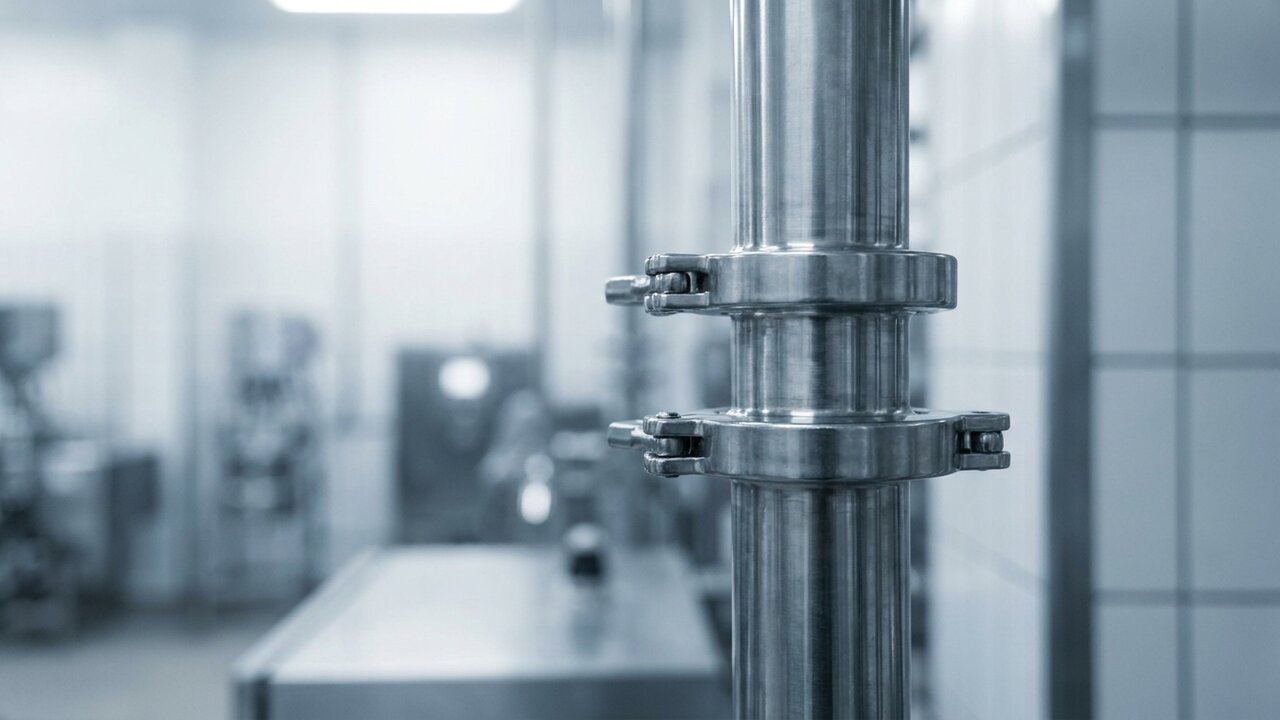
Connections matter too. Flanged joints, the default in general industrial piping, are rare in a hygienic line. Sanitary meters instead use Tri-Clamp (clamp ferrule) fittings for quick, tool-free removal and cleaning, or DIN 11851 threaded unions where the plant standard calls for them, allowing the meter to be pulled for inspection or CIP without leaving a gasket recess behind.
EHEDG and 3-A: The Certification Landscape in Plain Terms
Two certification schemes dominate hygienic equipment specifications. EHEDG (the European Hygienic Engineering & Design Group) certifies hygienic design against a defined test protocol, confirming a design can be cleaned effectively in place. 3-A, the longer-established North American sanitary standard, is widely referenced in UK dairy and food specifications too, and covers similar ground with its own criteria.
What certification guarantees is that the design has been independently assessed against a known standard, rather than described as hygienic by the manufacturer alone. What it does not guarantee is that any given installation performs hygienically: a certified meter fitted with the wrong gasket, mounted in a pocket that traps product, or left un-drained between cycles, is not delivering the hygienic performance its certificate implies. Certification is a statement about the design; hygiene in practice is a statement about the whole installation. An uncertified "stainless steel" meter, sold on material alone, is not the same thing as a hygienic meter.
CIP and SIP: Surviving the Cleaning Cycle
A sanitary flow meter has two jobs, and the second one rarely appears on a datasheet: it must survive the cleaning regime as well as measure the product. Clean-in-place (CIP) typically cycles a caustic wash, an acid rinse and a final rinse through the line without dismantling the pipework. Steam-in-place (SIP), where sterility is required, pushes live steam through the same line, commonly up to around 140 degrees Celsius.
Temperature cycling, not the chemistry alone, is the quiet killer of an unsuitable meter. A liner, seal or sensor rated for the product's normal operating temperature but not for repeated excursions to SIP temperature will degrade over months of cycles even though it appears to work perfectly on day one. Specifying a sanitary meter means specifying for the full duty cycle, product, CIP chemistry and SIP temperature together, not just the flow rate and fluid it measures most of the time.
The Honest Technology Shortlist for Food and Beverage
With the hygienic design requirements established, the question becomes which measurement technology actually suits the duty. Our general comparison of turbine, magnetic and ultrasonic technology covers the trade-offs across all sectors; hygienic duty narrows the honest shortlist considerably.
Electromagnetic (Hygienic Pattern): the Default for Conductive Product
For most liquid food and beverage duties, a hygienic-pattern electromagnetic flow meter is the default choice. It has no moving parts to wear, foul or trap product, handles milk, beer wort, sauces and the CIP fluid itself without distinction, and its accuracy is unaffected by viscosity within its operating range. The one condition that matters: the product must be electrically conductive. Most aqueous food and beverage products qualify comfortably.
Hygienic Turbine: for Clean Product and Pulse-Accurate Dosing
Where the product is clean and low-viscosity and the duty is dosing or batching rather than continuous line measurement, a hygienic turbine earns its place. Nixon carry the BNO hygienic turbine within our turbine flow meter range, built to sanitary standards rather than adapted from an industrial design. Its strength here is a fast, linear pulse output, exactly what a filling line needs when batch times are short. Our turbine meter guide covers K-factor and repeatability in detail, both of which apply equally to the hygienic pattern.
Coriolis: When Mass, Density or Concentration Is the Real Measurement
Where the actual measurement need is mass, density or concentration, Brix in a syrup, original gravity in a brewery, rather than volume, Coriolis is the honest answer regardless of cost. It measures mass flow directly and derives density from the same signal, which volumetric technologies cannot do. The trade-off is upfront cost, considerably higher than magnetic or turbine at the same line size, which is why we only recommend it where the process genuinely needs what it measures.
When Each Is Wrong
None of the above is universal. Electromagnetic fails outright on non-conductive product: oils have no place on a magnetic meter, and syrups sit in marginal territory depending on their conductivity, worth checking rather than assuming. Turbine struggles with anything particulate, fruit pulp, seed-bearing juices, any product carrying suspended solids, because particles foul the rotor and bearings; the same is true of high-viscosity products that push the rotor outside its calibrated range. On those duties, a different measurement approach is usually needed rather than forcing turbine or magnetic to cope.
Batching and Dosing: Why Repeatability Is the Money Number
Filling lines live and die on repeatability, not absolute accuracy. Repeatability is a meter's ability to give the same reading for the same flow condition, batch after batch; absolute accuracy is how close that reading sits to a reference standard. For fill-weight compliance, repeatability is what actually matters: a meter that is out by a fixed offset but perfectly consistent needs only a one-time correction, but a meter that varies unpredictably from batch to batch cannot be corrected for at all.
Short batch times punish a slow-responding meter particularly hard. A technology with a fast, linear pulse response, such as hygienic turbine, has a real advantage on quick-fill lines where there is barely time for flow to stabilise before the batch ends.
Installing a Sanitary Flow Meter in a Hygienic Plant
Getting a hygienic meter's design right on paper is only half the job; installing it correctly is the other half. Orientation matters more than in a general industrial line: a sanitary meter should be installed so the line self-drains rather than pooling product or CIP fluid in a low point, and it needs to remain fully floodable during the CIP cycle, no air pockets, no orientation that leaves part of the wetted path un-swept by the cleaning fluid.
Verification and calibration present their own hygienic challenge: pulling a meter for external calibration means breaking into a line that then has to be re-validated for hygiene before it returns to production. Where that is impractical, some plants use a portable clamp-on ultrasonic meter to spot-check flow from outside the pipe wall, without touching the product path at all; useful for a sanity check between full recalibrations, even though it will not itself form part of the permanent hygienic measurement.
Frequently Asked Questions
What is a sanitary flow meter?
A sanitary, or hygienic, flow meter is designed with a crevice-free wetted geometry, a smooth internal surface finish, food-grade wetted materials and hygienic connections, so it can be cleaned effectively in place without creating a site where product can collect and spoil.
What is the difference between EHEDG and 3-A certification?
EHEDG is the European hygienic design certification, testing whether a design can be cleaned in place to a defined standard. 3-A is the equivalent, longer-established North American sanitary standard, widely referenced in UK dairy and food specifications too. Both assess design; neither guarantees a specific installation is hygienic in practice.
Can flow meters survive CIP and SIP cleaning?
A properly specified sanitary meter is built to survive CIP chemistry (caustic and acid) and SIP temperatures, typically up to around 140 degrees Celsius, without the liner, seals or sensor degrading. The real risk is repeated temperature cycling, which unsuitable components fail to tolerate over months of use.
Which flow meter is best for milk or beer?
For most milk, beer wort and similar conductive liquid duties, a hygienic-pattern electromagnetic flow meter is the default: no moving parts, unaffected by viscosity, and equally at home measuring the CIP fluid used to clean the same line.
Do hygienic flow meters need special fittings?
Yes. Sanitary flow meters use hygienic connections, typically Tri-Clamp (clamp ferrule) fittings or DIN 11851 unions, rather than standard industrial flanges, so the meter can be removed for cleaning or inspection without leaving a gasket recess behind.
Getting the Specification Right
Specifying a flow meter for a food or beverage line is not simply choosing an accurate technology; it is choosing one that survives the cleaning regime as reliably as it measures the product. Geometry, surface finish, certification and cleaning cycle all sit alongside flow rate and fluid type in the specification, and getting any one of them wrong can turn an accurate meter into a contamination risk.
Hygienic duty is one of the few areas where the wrong meter is not just inaccurate but a contamination risk. If you are specifying for a food or beverage line, the Nixon team is happy to talk through the options, including the cleaning cycle, not just the product.


