Turbine vs Magnetic vs Ultrasonic: The Three Flow Meter Types Compared
Ask a single-technology specialist which meter you need and the answer is nearly always theirs. Nixon Flowmeters carries turbine, electromagnetic (magnetic) and ultrasonic flow meters, alongside variable area and other specialist ranges, so we start from a different position: we have nothing to sell until we know what is actually in the pipe.
This article is the comparison a single-technology vendor cannot write honestly. It sets out what each of the three main flow meter types does well, where each one lets a buyer down, and why the decision should start with the fluid rather than the meter. There is an application matrix you can read by row or by column, three worked examples drawn from installations we see regularly, and an honest section on the cases where none of the three is the right answer. Choosing between technologies is rarely a catalogue decision, and we would rather this article talked you out of the wrong meter than talked you into any particular one.
The Three Flow Meter Types at a Glance
Turbine
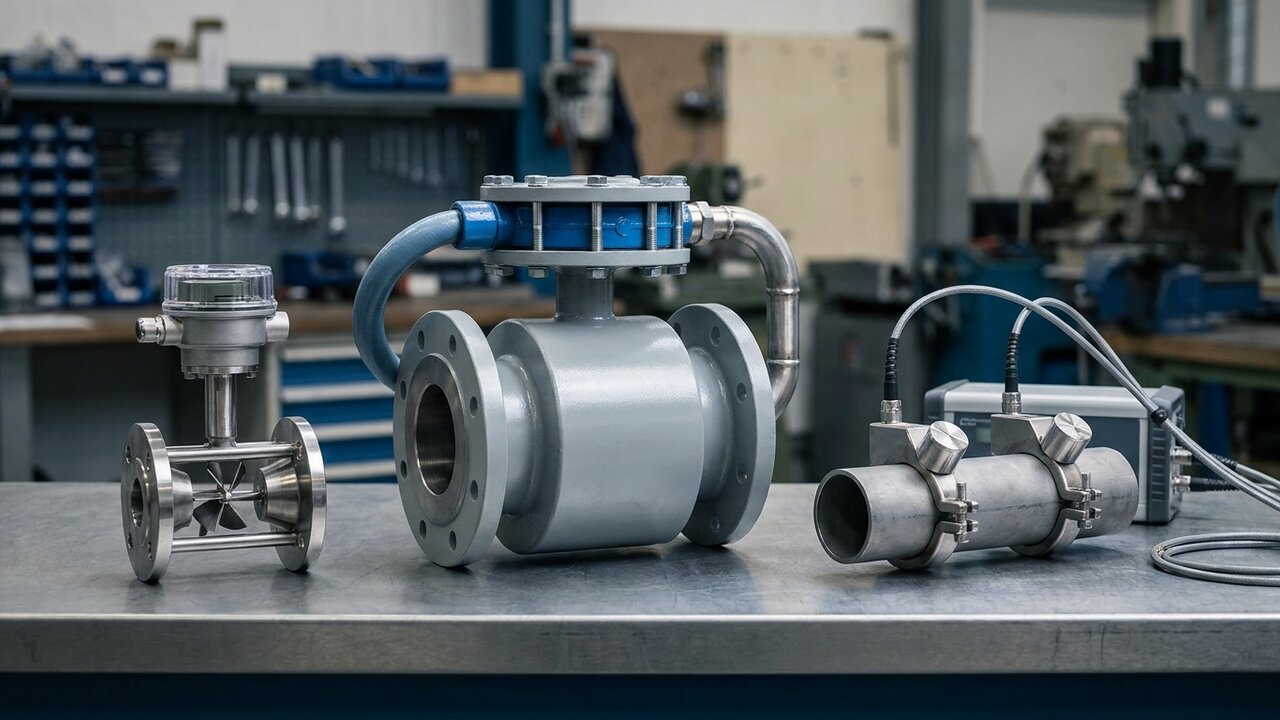
A turbine flow meter sits in the pipe and lets the fluid spin a small rotor; a pickup counts blade passes and produces a pulse train proportional to flow rate. Properly installed on a clean, low-viscosity fluid, it typically achieves 0.5 to 1 percent of reading, with repeatability often better than 0.1 percent, which is why it remains a default choice for custody transfer and batching. It needs a full pipe, adequate straight run and fluid clean enough not to wear the bearings; contamination ends a turbine meter's service life early, not old age. Our in-depth turbine flow meter guide covers K-factor, sizing and installation in full.
Magnetic
An electromagnetic (magnetic) flow meter applies Faraday's law: a conductive liquid moving through a magnetic field generates a voltage across a pair of electrodes, proportional to velocity. There are no moving parts and no obstruction to flow, so an accuracy around 0.5 percent of reading tends to hold for years rather than months. The condition is in the name: the liquid must be conductive, roughly 5 microsiemens per centimetre or above. Below that, or on any gas, a magnetic meter simply will not read.
Ultrasonic
An ultrasonic flow meter measures velocity by timing sound pulses through the fluid (transit-time) or by reading the frequency shift off particles and bubbles (Doppler). Clamp-on versions strap externally to an existing pipe with no process shutdown; inline versions are wetted and generally the more accurate of the two. Expect 1 to 2 percent of reading from a well-installed inline meter and 1 to 3 percent from clamp-on, more installation-dependent than either of the other two technologies, and heavily reliant on pipe condition and accurate bore data. Our clamp-on ultrasonic guide covers the non-invasive variant in detail.
So, Which Flow Meter Should You Use?
The decision starts with the fluid, not the meter. Is it conductive? Is it clean, or does it carry solids? Is it a liquid or a gas? How viscous is it? Answer those four questions honestly and the field usually narrows itself before accuracy, budget or pipe size even enter the conversation.
A rough route through it: conductive and possibly dirty water or wastewater points towards magnetic. Clean, low-viscosity liquid or gas needing high accuracy points towards turbine. A pipe that cannot be cut into, a very large bore, or a temporary verification job points towards ultrasonic. None of these are absolute rules, and plenty of applications sit on the boundary, which is exactly where a specialist conversation earns its keep rather than a spec sheet. For the wider buying process, including budget, calibration and installation planning, our comprehensive flow meter guide covers ground this article does not; this one stays focused on the technology choice itself.
Flow Meter Types Compared
| Metric | Turbine | Magnetic | Ultrasonic |
|---|---|---|---|
| Typical accuracy (installed) | 0.5-1% of reading | Around 0.5% of reading | 1-2% inline; 1-3% clamp-on |
| Fluid requirement | Clean, low-viscosity liquid or gas | Conductive liquid (roughly 5 µS/cm or above) | Any liquid; transit-time needs low solids and air |
| Moving parts | Yes: rotor and bearings | None | None |
| Pressure drop | Low | None | None |
| Relative cost | Low to moderate | Moderate to high | Moderate inline; very low install cost, clamp-on |
| Gas capability | Yes, with a gas-specific design | No | Limited; most models are liquid only |
| Slurry / dirty fluid capability | Poor: bearing wear | Good, with a lined meter | Poor on transit-time; Doppler variant copes |
| Typical sectors | Fuel, custody transfer, clean process gas | Water, wastewater, chemical processing | Large bore, surveys, verification, hygienic lines |
Read the table by column if you already know the technology you are considering. Read it by row if you are still at the application stage and want to narrow the field.
Where Each Technology Gets It Wrong
Turbine on the Wrong Fluid
Dirty, abrasive or viscous liquids wear the bearings and shift the calibration, and a turbine on pulsating flow, downstream of a reciprocating pump, tends to over-read because rotor inertia responds faster to a surge than it decelerates once the surge passes. Our turbine flow meters earn their keep on clean fluids; they are the wrong answer on anything else.
Magnetic on Non-Conductive Fluids and Gas
A magnetic meter has no answer for hydrocarbons, most solvents, deionised water or any gas: the liquid simply is not conductive enough to generate a signal. This is the most common magnetic mis-specification we see, usually from a buyer who has read "no moving parts, handles anything" without reading the small print. Our electromagnetic flow meter guide sets out where magnetic genuinely excels.
Ultrasonic on Aerated or High-Solids Liquids
Transit-time ultrasonic needs an acoustically clean fluid; entrained air or a high solids load scatters the signal and the reading becomes unreliable, sometimes without any obvious warning on the display. Clamp-on, in particular, is the wrong choice wherever money changes hands on the reading: custody transfer wants an inline meter with a certificate, not a clamp-on estimate however well it is installed. Our ultrasonic flow meters page covers the inline and clamp-on variants in more depth.
When None of the Three Is Right
Sometimes the honest answer is a fourth technology entirely.
High-viscosity liquids, heavy oils, syrups and adhesives among them, tend to defeat all three main types; an oval gear or other positive displacement meter, designed to trap and count discrete volumes of fluid regardless of viscosity, is usually the better answer.
Mass-critical duties, custody transfer by weight rather than volume, or Brix and density measurement in food and drink production, are a Coriolis meter's territory: it measures mass flow directly rather than inferring it from velocity, at a price that puts it beyond most general process applications.
Simple, low-cost local indication, a sight-glass reading on a cooling water branch or a rinse line where nobody needs a transmitter output, is still very often better served by a variable area meter than by digitising a duty that never needed digitising. Nixon are UK agents for Tecfluid (Spain), whose variable area range covers exactly this ground.
Cost of Ownership, Not Just Purchase Price
Purchase price rarely tells the whole story. A magnetic meter costs more to buy but has no wear parts and, on a well-maintained electrode, can run for a decade or more untouched. A turbine meter costs less up front, but the bearings are a genuine service item, and periodic recalibration against the certificate is the only way to confirm accuracy has not drifted. Clamp-on ultrasonic sits at the other extreme: installation cost is close to zero because nothing touches the process, though the transducer coupling should be checked periodically on a permanent installation. None of this makes one technology cheaper than another in absolute terms; it simply means the total cost depends on which part of the fluid's life you are measuring.
Three Applications, Three Answers
Borehole Water Into a Treatment Works
Conductive, occasionally carrying fine solids, on a medium to large bore main: magnetic is the straightforward answer, with no moving parts to fail on iron or manganese fouling and accuracy that holds for years.
Solvent Batching in a Chemical Plant
Clean and non-conductive, on a small bore line where batch consistency matters more than absolute accuracy: magnetic is ruled out by conductivity alone, so a turbine meter, sized correctly within its linear range, gives the repeatability the batching process actually needs.
Verification on a DN400 Cooling Main
A large-bore line where fitting a full-bore meter would mean a costly shutdown, for a one-off verification rather than permanent billing: a clamp-on ultrasonic survey, correctly mounted with good pipe data, does the job without touching the process at all.
Frequently Asked Questions
What are the main types of flow meter?
The three most widely specified are turbine, electromagnetic (magnetic) and ultrasonic, each suited to different fluids and applications. Beyond these, positive displacement, Coriolis and variable area meters cover viscous fluids, mass-critical duties and simple local indication respectively.
Which is more accurate, a turbine or a magnetic flow meter?
Turbine typically achieves 0.5 to 1 percent of reading, magnetic around 0.5 percent, so magnetic is marginally ahead on paper. In practice, installation quality affects both more than the gap between them, and turbine's repeatability often matters more for batching duties.
Can an ultrasonic flow meter replace a magnetic flow meter?
Sometimes, but not on accuracy grounds alone. Ultrasonic works on non-conductive fluids where magnetic cannot, and suits very large pipes better, but a well-installed magnetic meter usually beats ultrasonic on accuracy and long-term stability for conductive liquids like water and wastewater.
What flow meter works for non-conductive liquids?
Turbine and ultrasonic both work on non-conductive fluids such as hydrocarbons, solvents and deionised water; magnetic does not, because it relies on the liquid's conductivity to generate a signal. Viscous non-conductive fluids may suit positive displacement instead.
What is the cheapest type of flow meter?
Variable area meters are generally the lowest-cost option for simple local indication without a digital output. For a digital signal, clamp-on ultrasonic often has the lowest total installed cost, since it needs no pipework modification or process shutdown.
Which flow meter is best for dirty water or slurries?
A lined electromagnetic (magnetic) flow meter is usually the best choice for slurries and dirty conductive liquids, since it has no moving parts to wear or foul. Turbine bearings wear quickly on solids, and transit-time ultrasonic loses accuracy on high solids loads.
Can turbine flow meters measure gas?
Yes, provided the meter is designed for gas service, such as our own NTG Gas Turbine, rather than adapted from a liquid design. A gas turbine meter needs a lighter rotor and different bearings for the lower driving torque gas provides, plus pressure and temperature compensation.
Choosing the Right Technology
None of the three main flow meter types wins every application, and treating any of them as a default is how the wrong meter ends up in the wrong pipe. The fluid, the pipe, the accuracy actually required and who has to look after the meter once it is installed all shape the answer, and sometimes the answer is a fourth technology altogether. A flow meter comparison table takes you so far; a conversation about your specific fluid, pipe and duty takes you the rest of the way.
Choosing between technologies is rarely a catalogue decision, and we carry all three precisely so we do not have to bend the answer. If you would like an honest view on a specific application, the Nixon team is happy to advise.


