Ultrasonic Flow Meters: How They Work and When to Use Them
Ask which flow measurement technology has the widest gap between brochure accuracy and what actually turns up on site, and the honest answer, more often than any other technology Nixon supply, is ultrasonic. Get the variant, the liquid and the installation right, and an ultrasonic flow meter is quietly excellent: no moving parts to wear, no pressure drop, and accuracy that holds up in service. Get any one of those wrong, and the same meter still produces a confident reading; it is simply not a correct one.
Nixon Flowmeters has supplied and specified ultrasonic instruments since 1969, across water utilities, chemical plants, HVAC installations and process industries throughout the UK, alongside the turbine and magnetic ranges we also carry. This article sets out how ultrasonic flow measurement actually works, the split between transit-time and Doppler and the separate split between clamp-on and inline, the accuracy you can honestly expect from each combination, and where a different technology would genuinely serve you better. We would rather steer you towards magnetic or turbine than sell you an ultrasonic meter fitted to the wrong liquid.
How an Ultrasonic Flow Meter Works
An ultrasonic flow meter measures flow indirectly, using sound rather than a moving part to sense the liquid's velocity. Nixon supply both clamp-on and inline variants across our ultrasonic flow meter range; every version, and every ultrasonic flowmeter on the market, shares the same underlying idea: an ultrasonic pulse sent through a moving liquid is carried by that liquid, so the pulse's behaviour, its speed, its timing or its reflection, changes with the flow. Measure that change precisely enough, infer the average velocity across the pipe, multiply by the known bore area, and the result is a volumetric flow rate. Everything else, transit time, Doppler, clamp-on, inline, is a different way of extracting that same underlying signal.
There are two independent choices to make when specifying an ultrasonic meter, and it is worth keeping them separate: how the meter measures (transit time or Doppler), and how it is fitted to the pipe (clamp-on or inline). Brochures sometimes blur the two together. The practical differences, and the honest accuracy each combination delivers, are worth taking in turn.
Transit Time: Timing the Pulse
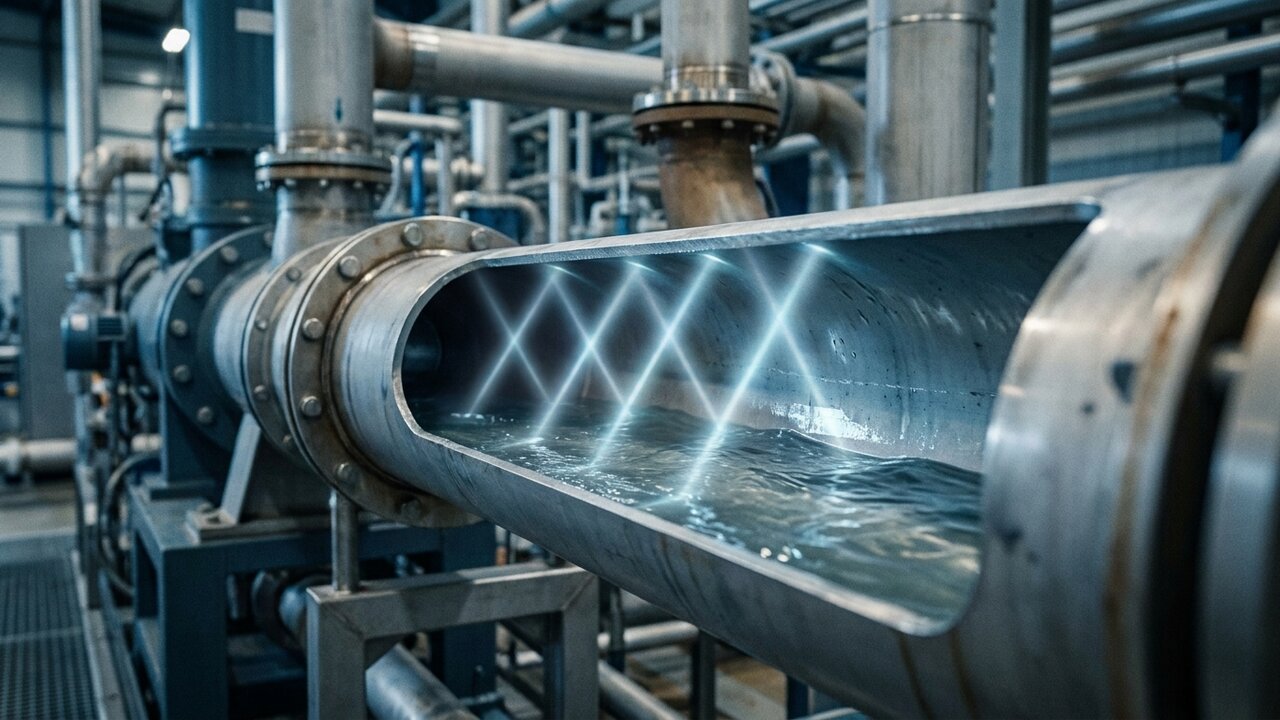
Transit-time ultrasonic is the dominant method for clean liquids, and the one both Nixon's clamp-on and inline ranges are built around. A pair of transducers is mounted diagonally across the pipe, not directly opposite one another, and each fires an ultrasonic pulse towards the other in turn: one travelling with the flow, one travelling against it. The pulse moving with the flow arrives fractionally sooner, because the moving liquid adds to the speed of sound through it; the pulse moving against the flow is fractionally delayed. That timing difference, measured in microseconds by the meter's electronics, is directly proportional to the average fluid velocity along the sound path.
The catch sits in the phrase "the pulse must survive the crossing." Transit time needs an acoustically clean liquid: heavy aeration, entrained gas or a high solids load scatters or absorbs the signal, sometimes preventing a reading altogether and sometimes corrupting it quietly, with no warning on the display. We cover this trade-off, and clamp-on installation practice specifically, in our clamp-on ultrasonic flow meter guide.
Doppler: The Mirror Image
Doppler ultrasonic works on the opposite principle, and needs exactly what transit time cannot tolerate. Rather than timing a pulse that must pass cleanly through the liquid, a Doppler meter reflects sound off particles or bubbles carried in the flow and measures the frequency shift in the returning echo; a clean liquid gives it nothing to bounce off and no reading at all. We have covered Doppler flow measurement properly, including where it earns its keep on slurries and aerated effluent, in a dedicated Doppler flow meter article rather than repeating it here. The rule that matters at specification stage: clean liquid, choose transit time; dirty or aerated liquid, choose Doppler.
Clamp-On vs Inline: The Second Axis
The second choice, independent of transit time versus Doppler, is how the meter is fitted to the pipe.
Clamp-on ultrasonic straps the transducers to the outside of an existing pipe: no cutting in, no shutdown, no wetted parts at all. It is the technology of choice for retrofitting flow visibility onto a line that already exists, and we cover the installation detail, the pipe conditions it needs and honest accuracy figures fully in our clamp-on ultrasonic guide. In short: typically 1 to 3 percent of reading, and unusually sensitive to installation quality for a technology with no moving parts.
Inline ultrasonic is a different proposition: a dedicated spool piece with wetted transducers built into it, calibrated as a complete unit before it ever reaches site. Because the transducer geometry and the pipe bore are fixed and known precisely at the factory, rather than measured and programmed in the field, inline ultrasonic delivers the tightest accuracy the technology offers: typically 0.5 to 1 percent of reading, comparable to a well-installed turbine meter. The trade-off is that fitting one means breaking into the line, exactly what clamp-on exists to avoid.
The table below sets out how the two axes combine in practice.
| Transit-time | Doppler | |
|---|---|---|
| Clamp-on | 1 to 3% of reading; no cutting into the pipe; needs a clean liquid and a sound pipe wall | Similar clamp-on accuracy range; needs particles or bubbles to reflect from, so suits dirty or aerated liquids |
| Inline | 0.5 to 1% of reading; factory-calibrated as a wetted spool piece; the tightest figure ultrasonic offers | Uncommon as a standard inline product; usually built into slurry-specific instruments rather than a general range |
Most enquiries we receive for ultrasonic flow meters land in the left-hand column of that table: transit time, on either a clamp-on or inline fitting, for a clean or moderately clean liquid. Doppler is a smaller, specialist share of enquiries, almost always where the liquid itself rules transit time out.
What Ultrasonic Uniquely Offers
Ultrasonic earns its place in the range for reasons no other flow technology fully replicates.
No moving parts and no pressure drop. Nothing spins, nothing wears, and the meter introduces no obstruction into the flow path, an advantage transit-time and Doppler share regardless of clamp-on or inline fitting.
Large diameters other technologies cannot serve economically. A turbine or magnetic meter at the same bore as a large water main becomes an expensive, heavy piece of equipment; clamp-on ultrasonic scales to large diameters at a fraction of the cost, since the transducers, not the pipe itself, are the product.
Non-conductive liquids magnetic flow meters cannot measure at all. Electromagnetic meters need a conductive liquid to work; oils, solvents and demineralised water fall outside that requirement, and ultrasonic is often the only practical non-invasive option left standing.
Hygienic, non-contact measurement. Where the process cannot tolerate a wetted sensor intruding into the flow, or where CIP cleaning regimes make wetted parts a liability, clamp-on ultrasonic measures without touching the product at all.
Honest Limitations
The honesty Nixon apply to every technology we sell applies here too.
Transit time fails on aerated or solids-heavy liquids. This is the mirror image of what makes it work: the pulse needs a clean path, and dosing chemicals, wastewater carrying suspended solids, or a liquid prone to entraining air will scatter or block the signal.
Clamp-on accuracy stands or falls on pipe condition and programmed dimensions. Get the wall thickness, material or lining wrong, or fit transducers to heavily corroded or scaled pipework, and the meter still gives a number; it is simply the wrong one. We set this out in full in the clamp-on article above.
Low-pressure gas needs a purpose-built gas ultrasonic instrument. Coupling an ultrasonic signal into a low-density gas is a fundamentally harder problem than into a liquid, and a meter designed for liquid service will not perform adequately on gas; this is a specialist product line, not a routine adaptation.
Cheap units with optimistic brochures are common in this category, more so than for turbine or magnetic meters. A datasheet accuracy figure quoted without qualifying the liquid, the pipe condition and the installation is not a figure worth specifying against.
Where a clean liquid needs better accuracy than ultrasonic delivers, our turbine flow meter guide sets out an alternative that typically holds 0.5 to 1 percent with excellent repeatability. Where the liquid is conductive and dirty, electromagnetic flow meters usually serve better than any ultrasonic variant. Our comparison of turbine, magnetic and ultrasonic technology covers the full trade-off between all three.
Where Ultrasonic Earns Its Keep
Sector by sector, ultrasonic's genuine strengths line up with specific, recurring duties.
Water distribution and leakage. Large-diameter mains where cutting in is impractical and clamp-on scales economically; a mainstay of leakage surveys and district metering.
HVAC and energy metering. Chilled and heating water circuits, where non-invasive, no-pressure-drop measurement suits retrofit energy audits without disturbing a running building.
Chemical processing, particularly non-conductive liquids. Solvents, oils and other duties that rule out magnetic measurement outright, where ultrasonic is often the only practical non-invasive choice.
Surveys and verification. Checking a suspect reading, benchmarking an installed meter, or gathering flow data before committing to a permanent installation, all suit a portable clamp-on unit.
Frequently Asked Questions
How does an ultrasonic flow meter work?
An ultrasonic pulse sent through a moving liquid is carried by that liquid, changing either the pulse's transit time (transit-time meters) or the frequency of its echo off particles (Doppler meters). The meter measures that change and calculates flow from it, using the pipe's bore area.
What is the difference between transit-time and Doppler ultrasonic meters?
Transit-time meters time a pulse crossing the liquid diagonally and need a clean, largely particle-free liquid for the signal to pass through undisturbed. Doppler meters reflect sound off particles or bubbles and need dirt or aeration in the flow to have anything to measure.
How accurate are ultrasonic flow meters?
Accuracy depends heavily on the variant and the installation. A factory-calibrated inline ultrasonic meter typically achieves 0.5 to 1 percent of reading; a well-installed clamp-on meter typically achieves 1 to 3 percent, with installation quality making the difference between the two ends of that range.
Do ultrasonic flow meters work on dirty liquids?
Standard transit-time meters need a relatively clean liquid; heavy solids or aeration scatter the signal. Doppler ultrasonic meters are built for the opposite case and need particles or bubbles present in the flow to work at all.
Can ultrasonic flow meters measure gas?
Yes, but only with a meter purpose-built for gas service. Coupling an ultrasonic signal into a low-density gas is a harder problem than into a liquid, and a standard liquid ultrasonic meter is not a suitable substitute.
Are clamp-on flow meters as accurate as inline meters?
Generally not quite. A well-installed clamp-on meter typically achieves 1 to 3 percent of reading, against 0.5 to 1 percent for a factory-calibrated inline unit, because inline meters are calibrated as a complete assembly rather than measured and programmed on site.
Getting the Specification Right
Ultrasonic is the technology where the gap between brochure accuracy and installed accuracy is widest, and closing that gap is mostly about choosing the right variant, transit time or Doppler, clamp-on or inline, for the liquid and the pipe in front of you. Full details of Nixon's ultrasonic flow meter range sit on our product page, alongside the turbine, magnetic and variable area alternatives we also supply, and our comprehensive flow meter selection guide sets the full range of technologies side by side.
If you would like an honest view on a specific application, the Nixon team is happy to advise.


